
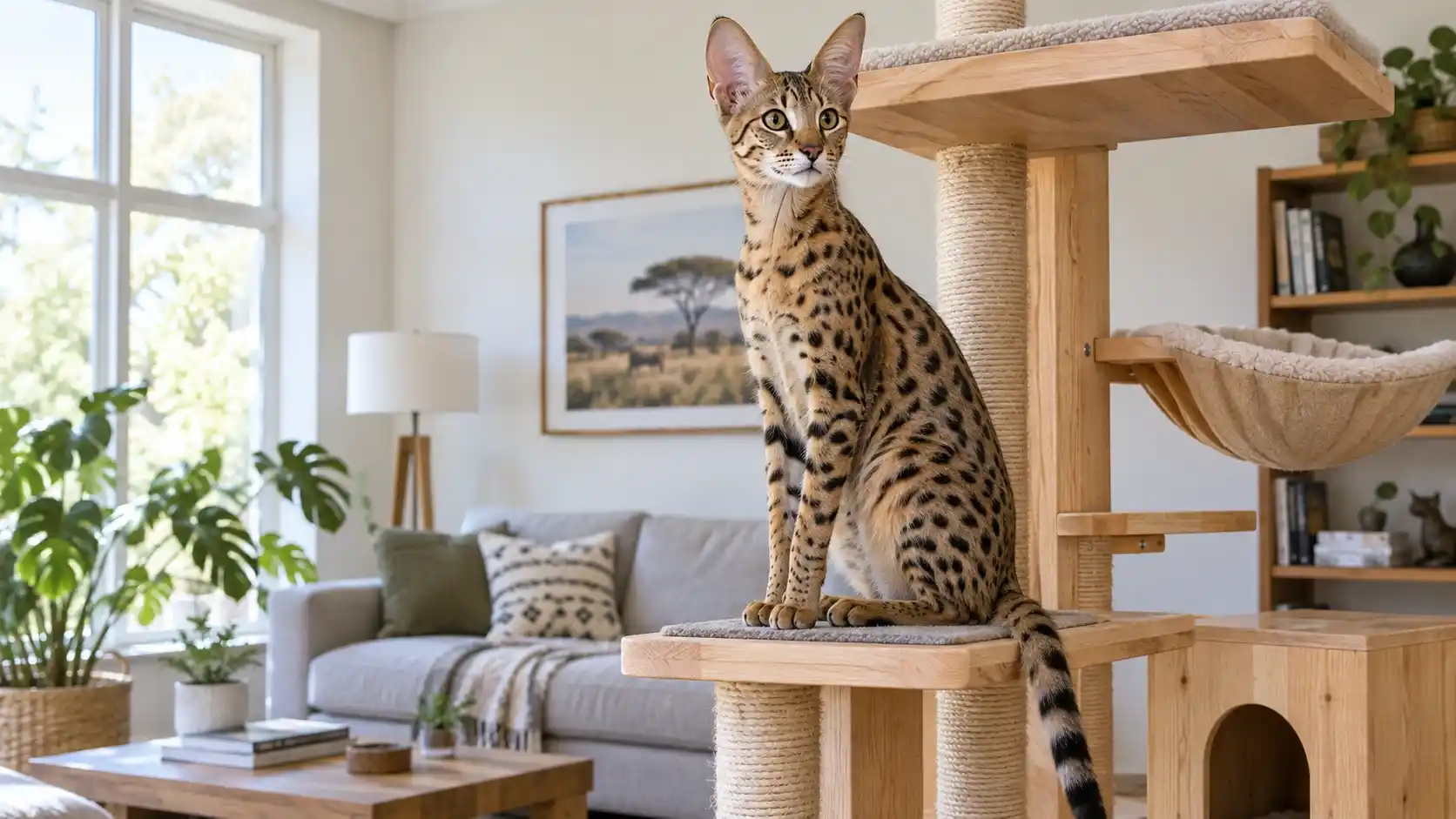
Savannah cat care looks nothing like caring for an average house cat, and many first-time owners learn that too late. These tall, spotted cats come from crossing a domestic cat with an African serval. They act like a mix of cat and dog, they never seem to run out of energy, and they need a lot of your time. This guide walks you through generations, laws, costs, food, play, training, and health so you can decide if a Savannah fits your life.
What Is a Savannah Cat?
A Savannah is a hybrid cat. Breeders cross a serval, a medium-sized wild cat from Africa, with a domestic cat. The result is a long-legged cat with big ears and a bold spotted coat. Savannahs are smart, curious, and very loyal. Many owners say their cat follows them from room to room, learns to fetch, and even walks on a harness.
F1, F2, F3 and Beyond
The F stands for filial, and the number tells you how many generations the cat sits from its serval ancestor. An F1 has a serval parent. An F2 has a serval grandparent. An F3 has a serval great-grandparent, and it continues from there.
- F1: The largest and wildest. Often around 50 percent serval, and best for experienced owners.
- F2: Still big and very active, though usually a little easier to live with.
- F3: Smaller and calmer, and often a better match for families.
- F4 and later: The most predictable in size and temperament, and legal in more places.
Size drops as the number goes up. F1 cats often weigh 19 to 23 pounds, while F3 cats are closer to 12 to 15 pounds. Most beginners do best with an F3 or later.
Check the Law Before You Fall in Love
Savannah cat laws depend on the generation and on where you live. There is no single federal rule in the United States. Georgia, Hawaii, Nebraska, and Rhode Island are commonly listed as states that ban them. Alaska, Colorado, Iowa, Massachusetts, New Hampshire, and Vermont generally allow only F4 or later. New York allows later generations, but New York City bans them. Some cities and counties add their own rules, and in the UK an F1 needs a licence.
Laws change, so call your state wildlife agency and your local animal control office before you buy. Do not rely on a breeder’s word alone.
What a Savannah Cat Really Costs
Price depends mostly on generation. These are rough ranges from breeders in the US:
- F1: about $12,000 to $20,000 or more
- F2: often $4,000 to $10,000
- F3: about $1,500 to $6,000
- F4 and later: roughly $1,000 to $5,000
Once your cat is home, plan on about $130 to $400 a month for food, litter, toys, insurance, and routine vet care. Setup costs like a large litter box, cat trees, and a harness add several hundred dollars more. Savannahs also wreck toys fast, so budget for replacements.
Setting Up Your Home
Savannahs jump far higher than most cats, so think vertical. Your goal is to give them safe places to climb before they pick their own.
- Tall cat trees, wall shelves, and perches
- Secure windows and screens
- A big litter box, since these cats are big
- Puzzle feeders and a rotating set of toys
- Latches on cabinets and doors, because many Savannahs learn to open them
Keep your Savannah indoors. If you want outdoor time, use a harness and leash or build a secure catio.
Feeding Your Savannah
These cats burn a lot of energy, so they need high-protein food. Pick a food with real meat as the first ingredient. Wet food helps with hydration, and many owners mix wet and dry. Feed measured portions on a schedule instead of leaving food out all day, because extra weight strains the joints and the heart.
Some owners feed raw, but raw diets are hard to balance. If you go that way, work with your vet or a veterinary nutritionist. Ask your vet before choosing a grain-free food too, since heart health matters in this breed. Keep fresh water available at all times. A fountain works well because many Savannahs love running water.
Exercise and Play
A bored Savannah is a destructive Savannah. Plan for at least two active play sessions every day. Wand toys, fetch, and climbing games all work well. Puzzle feeders give their brains a workout too. Many Savannahs enjoy water, so a shallow tray or a supervised splash can be a big hit. Harness walks add variety and burn extra energy.
Training and Socialization
Start young. Introduce your kitten to visitors, household noises, car rides, and the harness early. Use treats and praise, and never punish. Savannahs pick up tricks quickly and often respond well to clicker training.
Introduce other pets slowly, with a gate or a closed door first. Savannahs bond hard with their people, so long days alone can lead to loud crying and chewing. A second pet or plenty of enrichment can help.
Grooming
Grooming is the easy part. The short coat needs a weekly brushing. Trim nails every couple of weeks, brush teeth several times a week, and check the ears for wax or dirt. Most Savannahs do not need regular baths.
Health and Vet Care
Well-cared-for Savannahs often live 12 to 20 years. They are generally sturdy, but a few issues deserve your attention.
- Heart disease: Hypertrophic cardiomyopathy, or HCM, thickens the heart muscle. It affects an estimated 10 to 15 percent of all cats, and Savannahs are described as having a slightly higher risk. Ask breeders for heart screening results on the parents, and ask your vet about a heart ultrasound.
- Dental disease: Brush teeth and book regular cleanings.
- Medication sensitivity: Some owners and vets report that hybrid cats react strongly to certain vaccines, drugs, and anesthesia. Tell your vet you own a Savannah, and look for one with exotic or hybrid experience.
- Inherited conditions: Some lines carry problems like pyruvate kinase deficiency, so ask for genetic test results.
Plan yearly checkups and keep vaccines and parasite prevention current. Call your vet quickly if you see labored breathing, weakness, or sudden collapse. Price out pet insurance early, because it costs less when your cat is young and healthy.
Is a Savannah Right for You?
A Savannah suits you if you are home often, enjoy active play, and can handle a strong-willed cat on a real budget. It may not suit you if you work long hours away from home, want a quiet lap cat, rent under strict rules, or have very young children and want an early generation. Be honest with yourself here. It saves both you and the cat a lot of stress.
How to Find a Responsible Breeder
Good breeders are open and patient. Look for these signs:
- Registration with TICA and paperwork they happily share
- Health tests on both parents, including heart screening
- A chance to meet the parents, in person or on live video
- Kittens kept until around 12 weeks
- A written contract and support after the sale
Walk away if the price looks too good, the seller rushes you for a deposit, or they cannot prove the generation.
Savannah Cat Care FAQs
Are Savannah cats good for first-time owners?
They can be, especially later generations, if you commit the time and do your research. F1 and F2 cats suit people with more experience.
Can a Savannah live in an apartment?
Yes, as long as it has vertical space, daily play, and plenty of mental work.
Do Savannahs get along with kids and dogs?
Often yes, with early socialization. Supervise the first meetings and teach children to handle the cat gently.
more info: Russian Blue Cat Care: The Complete Owner’s Guide
Final Thoughts
Savannah cat care asks a lot, but it pays you back with a smart, loyal, and entertaining companion. Check your local laws first, pick a generation that matches your experience, and budget for the long run. Then build a home with climbing space, feed a high-protein diet, play every day, and stay close to a vet who knows hybrid cats. Do that, and you give your Savannah the best shot at a long, happy life.