
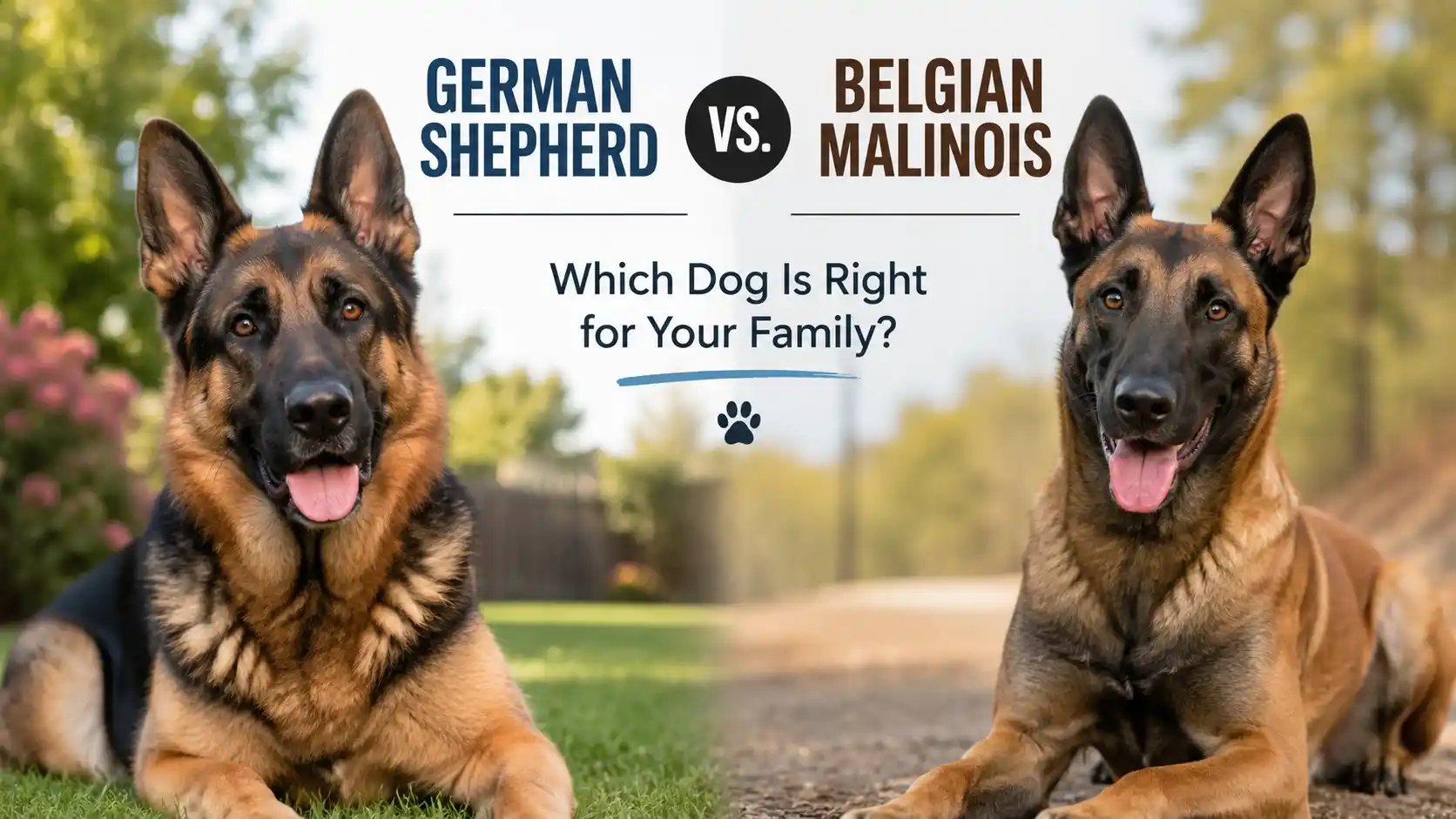
If you are comparing German Shepherd vs Belgian Malinois before bringing home a new dog, you are not alone. These two breeds get mixed up constantly, and it makes sense why. They look similar, they both show up in police and military work, and they are both famous for being smart and loyal. But once you live with them, the differences become obvious fast. One tends to settle into family life with ease. The other needs a job, a purpose, and an owner who can keep up. Let’s break down what actually separates them so you can figure out which one fits your home.
A Quick Look at Where They Come From
The German Shepherd was developed in Germany in the late 1800s as an all purpose farm dog. It herded sheep, guarded property, and handled just about any task a farmer needed. That background is why the breed turned out so adaptable. It could shift from working dog to family companion without much trouble.
The Belgian Malinois comes from Belgium, named after the city of Malines. It is one of four Belgian herding breeds, and it was built for speed, drive, and stamina. Unlike the German Shepherd, the Malinois was never really bred with the family home in mind. Its whole purpose centered on relentless work, and that instinct is still baked into the breed today.
Knowing this history helps explain almost everything else on this list.
Size and Physical Differences
At a glance, these breeds can look like siblings, but their builds are not identical.
German Shepherds are the larger of the two. Males typically stand around 24 to 26 inches at the shoulder and weigh between 65 and 90 pounds. They have a sturdier frame, a sloped back, and a thicker double coat that sheds heavily throughout the year.
Belgian Malinois are leaner and lighter. Most adults weigh between 55 and 75 pounds, with a squarer build built for agility and speed rather than raw power. Their coat is short and much easier to maintain, though they still shed a fair amount.
If you want a dog with serious physical presence, the German Shepherd delivers that. If you want a dog built like an athlete, the Malinois wins that comparison easily.
Temperament: The Real Deciding Factor
This is where most families should really focus, because temperament affects daily life far more than looks ever will.
German Shepherds tend to be:
- Calm and patient once they mature
- Deeply bonded to the whole family, not just one person
- Confident but not usually hyper reactive
- Willing to relax on the couch after their exercise needs are met
Belgian Malinois tend to be:
- Intense, alert, and almost always in motion
- More likely to bond closely with one specific person
- Reserved or aloof around strangers without heavy socialization
- Driven by a need to work, with little interest in simply lounging around
One trainer who works with both breeds often describes the Malinois as a go, go, go dog with almost no off switch, while German Shepherds are more willing to shift into relaxed family mode once the workday is done. That single difference tends to matter more to most households than anything else on this list.
Energy Levels and Exercise Needs
Both breeds need real exercise. Neither is a good fit for a sedentary lifestyle. But the intensity is not the same.
German Shepherds usually need about an hour of solid exercise a day. This can include walks, play sessions, and some mental stimulation through training or puzzle toys. Once that need is met, most German Shepherds are content to settle down for the rest of the day.
Belgian Malinois often need more than that, and the exercise has to be meaningful. A simple walk around the block rarely cuts it. These dogs thrive with running, agility training, structured obedience work, or dog sports like Schutzhund. Without enough outlet, a Malinois can become anxious, destructive, or overly reactive. This is a breed that genuinely needs a job, even if that job is just advanced training drills at home.
If your family has a busy but ordinary schedule, the German Shepherd is far more forgiving. If someone in your household is committed to serious daily training and activity, the Malinois can thrive.
Trainability and Intelligence
Both breeds rank among the smartest dogs in the world, so intelligence is not really the differentiator here. What differs is how easy that intelligence is to work with.
German Shepherds are typically easier for first time owners. They respond well to positive reinforcement, are eager to please, and pick up commands quickly without needing an especially experienced handler.
Belgian Malinois are just as smart, sometimes smarter in terms of raw drive, but they need a confident and consistent handler. Their intensity means training has to be structured and engaging, or the dog can become bored and start finding its own entertainment, which usually is not what you want in a house with furniture and small children.
Good With Kids and Other Pets
For most families, this is the deciding question.
German Shepherds are generally considered more patient with children. Their loyalty spreads across the whole household, and with proper socialization, they tend to get along well with other pets too.
Belgian Malinois can absolutely live peacefully with kids and other animals, but it takes more consistent supervision and early socialization to get there. Their high prey drive and intensity mean interactions with small children or small pets should always be closely watched, especially in the early years.
Neither breed should be left unsupervised with very young kids, but if you are choosing based purely on ease and predictability, the German Shepherd has the edge here.
Health and Lifespan
Both breeds are generally healthy, though like most purebred dogs, they carry some genetic risks.
German Shepherds are prone to hip and elbow dysplasia, along with certain digestive issues. Their average lifespan runs about nine to thirteen years.
Belgian Malinois tend to have fewer joint problems thanks to their lighter frame, though hip dysplasia can still occur. Some lines are also prone to eye conditions, so a veterinary eye exam is worth asking about before adopting. Their average lifespan is similar, typically ten to fourteen years.
Choosing a responsible breeder who screens for these conditions matters more than the breed choice itself when it comes to long term health.
Grooming Needs
German Shepherds have a dense double coat that sheds heavily, especially during seasonal changes. Expect regular brushing, at least a few times a week, to manage the shedding.
Belgian Malinois have a shorter coat that is easier to maintain overall, though they still shed noticeably. Weekly brushing is usually enough to keep things under control.
If shedding is a major concern for your household, the Malinois has a slight advantage, though neither breed is considered low maintenance in this department.
Which One Fits Your Family
If you want a loyal, adaptable dog that can handle an active but normal family routine, the German Shepherd is usually the safer and easier choice. It bonds with everyone in the house, tolerates a slower pace once its needs are met, and tends to be more forgiving for first time owners.
If your household is built around serious activity, structured training, and someone who genuinely wants a working partner rather than a couch companion, the Belgian Malinois can be an incredible dog. Just go in with realistic expectations about the time and energy this breed demands.
more info: French Bulldog Health Problems
Final Thoughts
Both the German Shepherd and Belgian Malinois are intelligent, loyal, and capable dogs, but they are not interchangeable. The German Shepherd tends to fit more comfortably into everyday family life, while the Belgian Malinois needs an owner ready to match its intensity every single day. Think honestly about your daily schedule, your experience with dogs, and how much time you can realistically commit before making your choice. Either breed can become an incredible companion, as long as their needs actually match your lifestyle.