
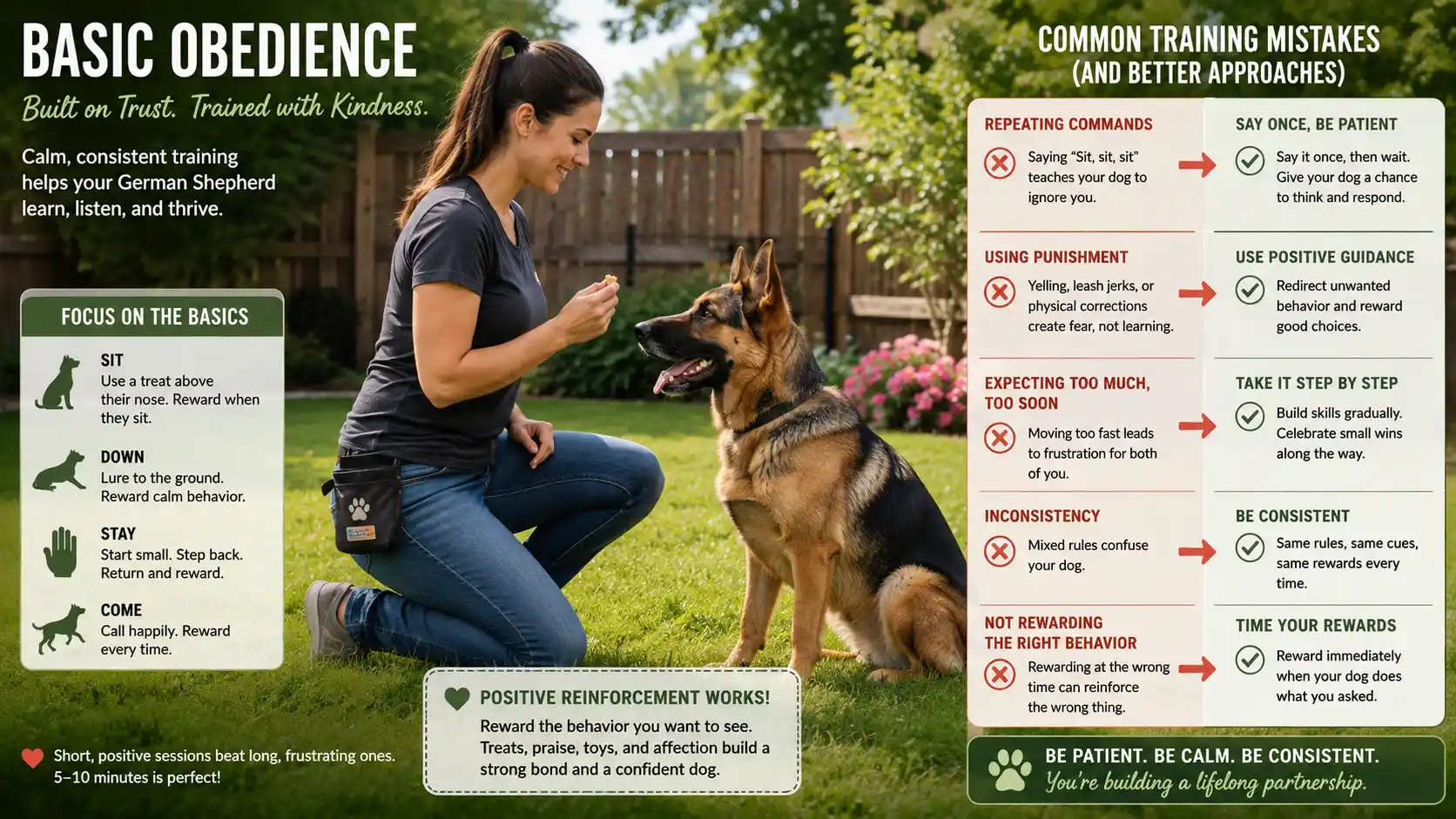
German Shepherd training is not something you can figure out by accident. This breed is smart, driven, and full of energy, and that combination means small errors in training can turn into big behavior problems if you are not careful. Many owners bring home a German Shepherd puppy expecting an easy, natural learner, only to find themselves stuck with a dog that pulls on the leash, ignores commands, or reacts to every little thing on a walk. The good news is that most of these problems come from a handful of common mistakes, and every one of them is fixable once you know what to look for.
This guide walks through the training mistakes that trip up German Shepherd owners the most, and what to do instead so your dog grows into the confident, obedient companion this breed is known for.
Why German Shepherd Training Needs a Different Approach
German Shepherds were bred to work. They herded livestock, guarded property, and later became one of the top choices for police and military work. That history is still in their genes. A German Shepherd needs a job to do, both mentally and physically, or it will find its own ways to stay busy, and those ways are usually not the ones you want.
This is why generic dog training advice does not always work well for this breed. German Shepherds pick up on inconsistency fast, they get bored with repetition faster than most breeds, and they respond better to clear leadership than to force. Once you understand that, the mistakes below start to make a lot more sense.
Mistake 1: Starting Training Too Late
A lot of new owners think formal training should wait until the puppy is five or six months old. This is one of the biggest missteps you can make. The early weeks of a puppy’s life, roughly from three weeks to fourteen weeks, are when their brain is most open to learning and forming habits. Waiting until the dog is older means you are trying to build good habits on top of behaviors that already feel normal to the dog.
Start simple training the day your puppy comes home. This does not mean drilling commands for hours. It means teaching basic manners like sitting before meals, walking calmly on a leash, and responding to their name. Short, gentle sessions early on build a foundation that pays off for years.
Mistake 2: Skipping Socialization
Some owners keep their puppy isolated until vaccinations are fully complete, worried about disease exposure. While vaccination timing matters, waiting too long to introduce your puppy to new people, animals, sounds, and environments carries its own risk. Under-socialized German Shepherds often grow into adults that are nervous, overly protective, or reactive toward strangers and other dogs.
Talk to your vet about safe ways to socialize early, such as controlled introductions in your own yard, short car rides, and meeting vaccinated, friendly dogs. The goal is to show your puppy that the world is not something to fear. A well socialized German Shepherd is calmer, more confident, and far easier to manage as an adult.
Mistake 3: Being Inconsistent With Commands and Rules
German Shepherds are perceptive, and they notice patterns quickly. If you say “down” one day and “lie down” the next, or if you allow jumping on the couch sometimes but not other times, your dog is not being stubborn. It is confused.
Consistency needs to cover a few areas:
- Use the same word for each command every time.
- Set house rules and stick to them, whether you are tired or busy.
- Make sure everyone in the household follows the same rules and commands.
If one family member allows the dog on the bed and another does not, the dog is stuck trying to guess which rule applies. That uncertainty slows down training and can create anxiety over time.
Mistake 4: Relying on Harsh Corrections
German Shepherds are eager to please, but they are also sensitive to how they are treated. Yelling, physical punishment, or overly harsh corrections do not teach a dog what to do instead. They often just teach the dog to fear you or to hide the behavior when you are not looking.
Positive reinforcement works better for this breed. Reward the behavior you want with treats, praise, or play, and redirect unwanted behavior calmly. If your puppy is chewing on your shoe, do not scream at it. Take the shoe away and give it an approved chew toy instead. Over time, this builds trust instead of fear, and a German Shepherd that trusts you is far more responsive.
Mistake 5: Not Giving Enough Mental Stimulation
This breed is one of the smartest in the world, and that intelligence needs an outlet. A German Shepherd that only gets physical exercise, like a walk around the block, can still end up bored and destructive. Mental fatigue matters just as much as physical fatigue for this breed.
Add variety to your routine with:
- Puzzle toys that make the dog work for treats
- Short training games that change from day to day
- Scent work, such as hiding treats around the house or yard
- New walking routes instead of the same path every time
A mentally tired German Shepherd is a calmer, easier dog to live with.
Mistake 6: Repeating Commands Over and Over
It is a common habit. You say “sit,” the dog does not respond right away, so you say it again, and again. Without realizing it, you are teaching your dog that the first command does not really matter and that it can wait for the third or fourth repeat.
Give the command once. If the dog does not respond, guide it into position gently or use a treat to prompt the action, then reward it. This teaches your German Shepherd that commands mean something the first time you say them, which makes training far more reliable in the long run.
Mistake 7: Giving Too Much Freedom Too Soon
New owners often feel guilty keeping a puppy on a leash or in a confined space at home, so they let the dog roam the house freely before it has earned that trust. A German Shepherd puppy with too much freedom too early often ends up chewing furniture, having accidents, or developing habits that are hard to break later.
A better approach is to expand freedom gradually. Start with a crate or a small, puppy-proofed area, and increase the space as your dog shows it can be trusted. This is not about being harsh. It is about setting your dog up to succeed instead of setting it up to make mistakes you then have to correct.
Mistake 8: Skipping Real Leash Training
German Shepherds are strong and can pull hard once they build muscle, so leash manners need to be taught early, not left for later. Many owners let a puppy pull gently on the leash because it seems harmless at that size, without realizing the same habit becomes a real problem once the dog weighs seventy or eighty pounds.
Teach loose leash walking from the start. Stop walking the moment the leash goes tight, and only continue once your dog returns to your side. This simple, consistent response teaches the dog that pulling gets them nowhere, while walking calmly keeps the walk moving.
Mistake 9: Ignoring the Breed’s Natural Traits
Some owners try to train a German Shepherd the same way they would train a laid-back, low-energy breed, and then get frustrated when the results do not match. This breed needs structure, a clear routine, and a sense of purpose. Without it, their intelligence can turn into stubbornness or anxious behavior.
Understand what your dog was bred for. Give it a job, whether that is structured obedience practice, agility, tracking games, or simply a consistent daily routine of walks and training. A German Shepherd with a purpose is a far easier dog to train than one left without direction.
Mistake 10: Expecting Quick Results
Training a German Shepherd is not a one week project. Owners who expect fast results often give up on a method too soon or jump between different training styles, which only adds to the dog’s confusion.
Real progress usually shows up over several weeks of steady, short daily sessions. Stick with one consistent approach, track small improvements, and give your dog time to build the habit. Patience is often the difference between an owner who succeeds and one who struggles.
Bringing It All Together
Most German Shepherd training problems trace back to a few root causes: starting too late, being inconsistent, using the wrong kind of corrections, or not giving the dog enough mental and physical outlets. None of these mistakes are permanent. Once you spot them, you can adjust your approach and start seeing real changes within a few weeks.
Keep your training sessions short, clear, and consistent. Reward the behavior you want, redirect the behavior you do not, and remember that this breed thrives on structure and leadership rather than fear. With patience and the right approach, your German Shepherd can grow into exactly the loyal, well behaved companion you pictured when you brought them home.