
Introduction
Bringing home a Golden Retriever puppy is exciting, but the first few months set the tone for the rest of your life together. If you are looking into golden retriever puppy training, you are probably staring at a fluffy little troublemaker who is equal parts adorable and exhausting. Goldens are smart, eager to please, and genuinely want to make you happy, which makes them one of the easier breeds to train. But easy does not mean automatic. Without the right approach early on, that same intelligence can turn into stubborn habits that are harder to fix later. This guide covers the practical training steps every new owner needs, from the first day home through basic obedience, so you can raise a well behaved dog without the stress.
Start Training From Day One
A lot of new owners think training begins once the puppy settles in after a week or two. That is a mistake. Your puppy starts learning the moment they walk through your door. Every interaction teaches them something about what gets your attention, what earns rewards, and what does not work. If you wait to start, your puppy will already have picked up habits on their own, and some of those habits will not be ones you want.
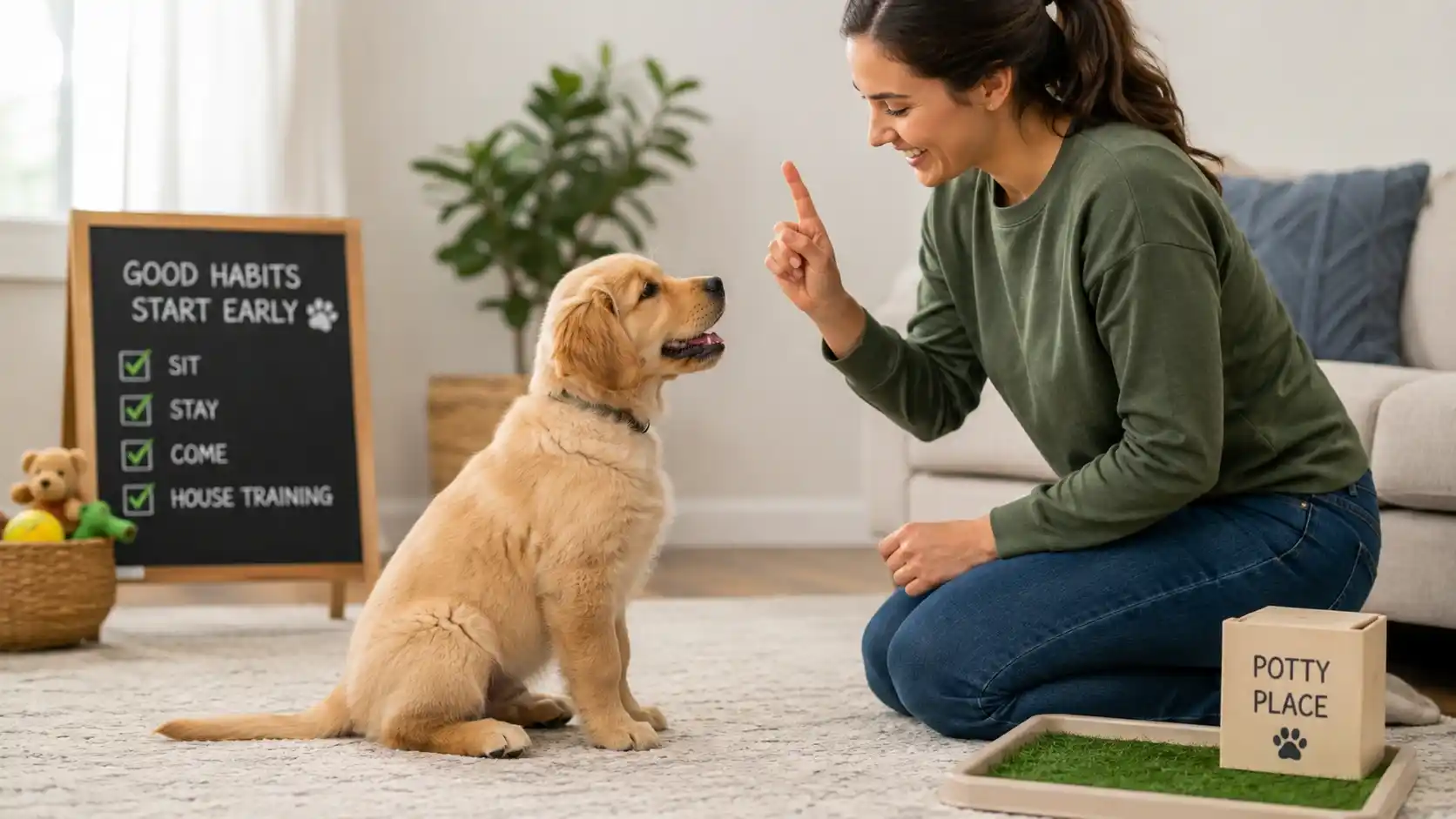
Keep your first lessons simple. Teach your puppy their name by saying it once and rewarding them the second they look at you. Use mealtimes as training opportunities too. A single piece of kibble can reward a small behavior like sitting or making eye contact. This turns feeding time into several mini training sessions throughout the day without extra effort on your part.
Keep sessions short, around three to five minutes at a time, several times a day. Puppies have short attention spans, and long drawn out sessions lead to boredom and frustration on both ends.
House Training Basics
Potty training is usually the first real challenge new owners face, and it is also the one that causes the most stress. The good news is that Golden Retrievers tend to catch on quickly compared to many other breeds, often becoming reliably house trained within a month of consistent effort.
Here is a schedule that works for most puppies:
- Take them outside first thing in the morning, right after they wake up
- Go out again after every meal
- Head outside after every play session
- Add a bathroom break roughly every sixty to ninety minutes while your puppy is awake
Leash your puppy for these outdoor trips, even in your own yard, so you can confirm they actually went. Pick one consistent spot and use the same cue every time, something simple like “go potty” works well. When they finish, praise them enthusiastically. Puppies respond strongly to excitement in your voice, so do not hold back.
If an accident happens indoors, do not scold your puppy. Punishment tends to increase anxiety and can actually slow down house training progress instead of speeding it up. Clean the area with an enzymatic cleaner so the smell does not draw your puppy back to the same spot. Then simply tighten up your supervision and schedule going forward.
Crate Training Done Right
Crate training and house training go hand in hand. Dogs naturally avoid soiling the space where they sleep, so a properly sized crate becomes a powerful tool for teaching bladder control. The key word is properly sized. Your puppy should have enough room to stand up, turn around, and lie down comfortably, but not so much extra space that they can use one corner as a bathroom.
Introduce the crate slowly and never as a punishment. Leave the door open at first and toss a few treats inside so your puppy discovers them on their own. Add a favorite toy or a stuffed chew to make the space more appealing. Once your puppy goes in and out on their own without hesitation, start closing the door for short periods while you stay nearby, then gradually increase the time and distance.
Most Golden Retriever puppies benefit from sleeping in their crate at night for the first year. This keeps accidents to a minimum and helps them settle into a predictable routine. If your puppy whines in the crate, resist the urge to let them out immediately, since that teaches them that whining works. Instead, wait for a moment of quiet before opening the door.
Leash Training and Walking Manners
Golden Retrievers are strong, energetic dogs, and without leash training, walks can turn into a wrestling match. Start indoors before you ever step outside. Put a properly fitted harness or collar on your puppy and let the leash trail behind them under supervision while they explore the house. This gets them used to the feeling of wearing gear without any pressure attached to it.
Once your puppy is comfortable, begin short practice walks in a low distraction area like your backyard or hallway. Reward loose leash walking with treats and praise, and stop moving the moment they pull. Puppies quickly learn that pulling gets them nowhere, while walking calmly beside you keeps the walk going.
Golden Retrievers are also easily distracted by other dogs, people, and interesting smells, so patience matters here. Short, frequent practice sessions beat one long frustrating walk every time.
Basic Obedience Commands
Once your puppy has the basics of house manners down, you can start layering in obedience commands. Focus on the essentials first, since these form the foundation for everything else:
- Sit, which is often the easiest command to teach and builds early confidence
- Stay, which takes more patience but is essential for safety
- Come, which should be practiced constantly since a reliable recall can be lifesaving
- Down, useful for calming an excited puppy in busy situations
Use positive reinforcement for all of these. Treats, praise, and favorite toys work far better than corrections with this breed. Golden Retrievers are sensitive dogs at heart, and harsh training methods tend to create anxiety rather than obedience. Keep instructions clear and consistent, and make sure everyone in the household uses the same words and hand signals so your puppy is not confused by mixed messages.
Socialization Matters as Much as Obedience
Training is not just about commands. Socialization shapes how confident and well adjusted your Golden Retriever becomes as an adult. The first few months of a puppy’s life are the best window for this kind of exposure. Introduce your puppy to different people, other vaccinated dogs, various sounds, and new environments in a calm and positive way.
Puppy classes are worth considering here. They combine structured training with controlled socialization, giving your puppy practice around distractions while you learn proper technique from a professional. Even simple outings like car rides, walks in new neighborhoods, or visits to a friend’s house all count toward building a confident, adaptable dog.
Handling Common Puppy Behaviors
Golden Retriever puppies are notorious chewers. This is partly teething and partly their retrieving instinct looking for an outlet. Instead of trying to eliminate the behavior entirely, redirect it. Keep a variety of appropriate chew toys around the house and swap them out when your puppy starts gnawing on furniture or shoes.
Nipping during play is another common issue, especially since Goldens use their mouths to interact with the world. When your puppy nips too hard, let out a short yelp and stop playing for a moment. This mimics how littermates teach bite inhibition and helps your puppy learn to soften their mouth over time.
Jumping up to greet people is cute at eight weeks old and much less cute at seventy pounds. Address this early by only giving attention when all four paws are on the ground, and ask guests to do the same rather than encouraging the jumping.
Staying Consistent for Long Term Success
The single biggest factor in successful golden retriever puppy training is consistency. Dogs learn through repetition and predictable outcomes. If sitting sometimes earns a treat and sometimes gets ignored, your puppy will struggle to understand what you actually want. The same goes for household rules. If jumping on the couch is fine on weekends but not on weekdays, your puppy has no way to know the difference.
Set your rules early, communicate them clearly to everyone in the house, and stick with them. Training a Golden Retriever puppy takes time and patience, but the payoff is a loyal, well mannered companion who genuinely enjoys learning and working with you.
more info: The Complete Labrador Retriever Care Guide for New Owners
Final Thoughts
Training a Golden Retriever puppy does not require anything complicated. It comes down to starting early, staying consistent, and using positive reinforcement instead of punishment. Focus on house training and crate training first, layer in leash manners and basic commands, and make socialization a regular part of your routine. Stick with these habits and your puppy will grow into a confident, well behaved dog who is genuinely a joy to live with.