
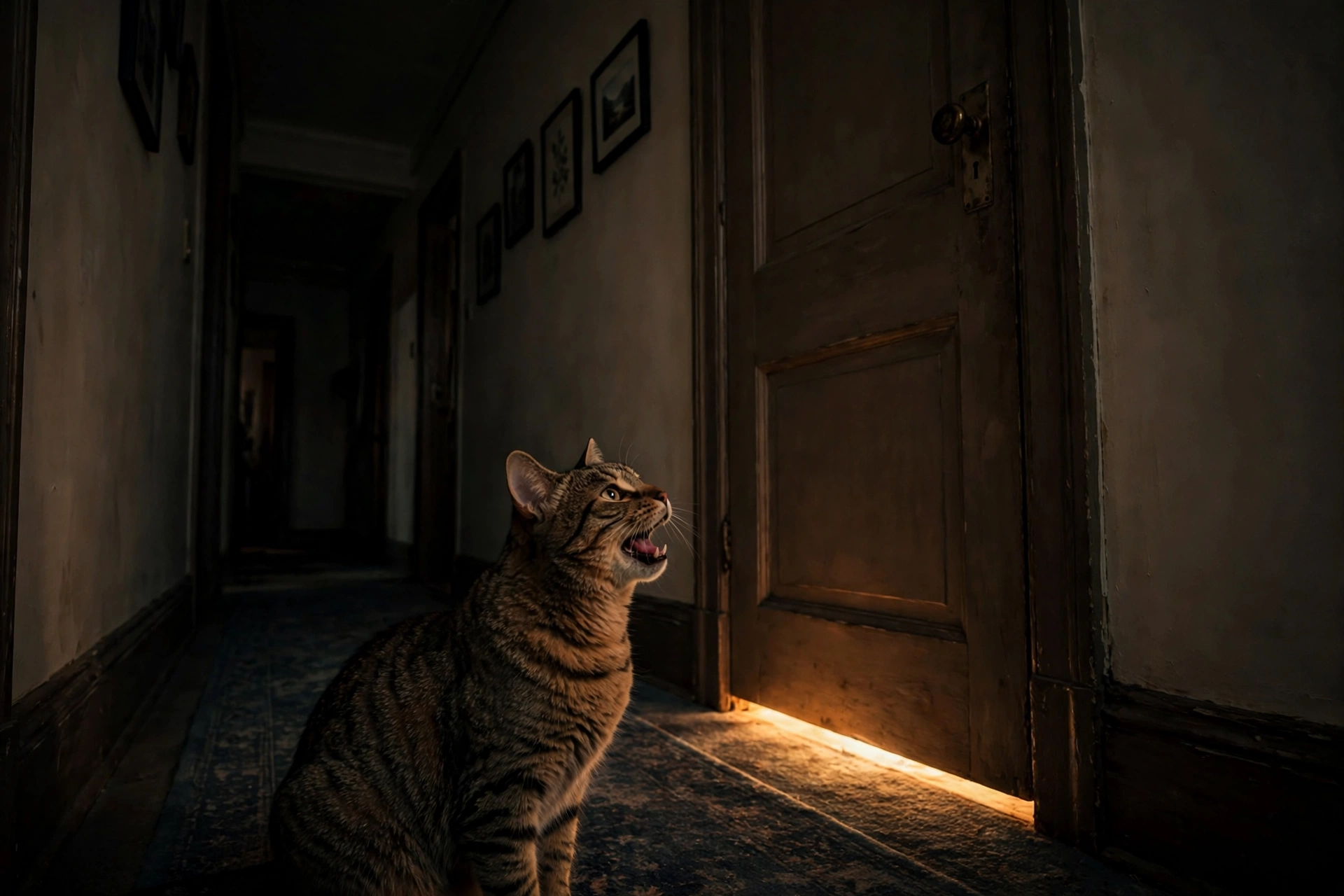
Quick answer: Most cats meow at night because they are built to be active at dusk and dawn, they slept all day, and the house has gone boringly quiet. Many have also learned that a 3 a.m. performance gets you up. In senior cats, though, new night vocalizing can signal thyroid trouble, high blood pressure, or cognitive decline. Young and healthy usually means habit. Old or suddenly changed means vet first.
Why Cats Meow at Night
A cat’s body clock is set for twilight. In the wild, dawn and dusk are hunting hours, and your cat’s ancestors kept the schedule even though dinner now arrives in a bowl. When the house sleeps, your cat’s most awake hours begin.
So, why does my cat meow so much at night, and always outside my door? Because nighttime stacks everything a cat wants: energy to burn, a quiet house where a meow carries, and an audience that history says will eventually respond. Meowing, remember, is a tool cats aim at humans. Adult cats rarely meow at each other. This guide sorts the causes by age, covers the bedtime routine that genuinely works, and flags the medical version that should never be trained away.
The Usual Causes in Young and Middle Aged Cats
- The twilight engine: Cats are crepuscular. A cat who napped through your whole workday wakes up at midnight genuinely rested and ready, and the house offers nothing to do.
- Boredom and stored energy: An indoor day with no hunting, chasing, or climbing ends in a cat with a full battery at the exact hour you want sleep.
- The learned wake up call: Every response teaches. Getting up, talking, shooing, or feeding at 3 a.m. all count as success to a cat. Many night meowers are simply well trained by exhausted owners.
- Hunger timing: A cat fed at 6 p.m. may be honestly empty by 3 a.m., and a meow has historically fixed that.
- A call you answered yesterday: Cats who hide from daytime noise often choose the quiet night to ask for the attention they skipped, much like the shy cats in our cat suddenly hiding guide choose odd hours to reappear.
- Unspayed and unneutered cats: A female in heat yowls, and an intact male who smells one joins in. This is hormones, not habit, and it is loud enough to settle the spay and neuter question on its own.
The Causes That Matter in Senior Cats
A cat over 10 who starts vocalizing at night deserves a vet visit before any training plan, because the common causes here are medical:
- Hyperthyroidism: An overactive thyroid is common in older cats and classic for restlessness and night yowling, often with weight loss despite a good appetite.
- High blood pressure: Often linked to thyroid or kidney trouble, it can cause discomfort, disorientation, and vocalizing, and it can threaten vision if ignored.
- Cognitive dysfunction: Aging cats can become confused at night, forgetting where they are or why the house is dark, and calling out in genuine disorientation.
- Failing senses: A cat losing hearing often meows louder, simply because she cannot gauge her own volume. Vision loss makes dark rooms genuinely unsettling.
- Pain: Arthritis and other age related pain worsens at night when distractions end and stiff joints announce themselves.
Senior meowing is a symptom wearing a habit’s clothes. Rule out the body first. The Cornell Feline Health Center publishes clear owner guidance on hyperthyroidism and aging cats for anyone who wants to read ahead of the appointment.
How to Restore the Night (Step by Step)
- Vet check first when it fits the medical pattern. Senior cat, sudden change, or any appetite, thirst, or weight shift: book the appointment before step two.
- Run the hunt, catch, eat routine before bed. Play hard with a wand toy for 10 to 15 minutes late in the evening, let your cat catch the toy at the end, then serve dinner or a protein rich snack. This mirrors the wild sequence of hunt, eat, groom, sleep, and it is the single most effective change most owners can make. The protein options in our can cats eat chicken guide fit the slot well.
- Move dinner later. A fed cat is a sleepy cat. Shifting the last meal toward your bedtime closes the 3 a.m. hunger gap.
- Use a timed feeder for the dawn shift. If 5 a.m. meowing is breakfast lobbying, an automatic feeder set for that hour teaches the cat to lobby the machine instead of you.
- Then ignore, completely and together. Once health is cleared, everyone in the house must stop responding at night: no talking, no feeding, no pillow throwing. Expect two or three louder nights first, because behaviour that worked always gets one bigger try before it fades. Most cats give up within one to two weeks of true consistency.
- Enrich the day. Puzzle feeders, a window perch, a morning play session. A cat who hunts by day sleeps by night, and daytime treats like the small pleasures in our can cats eat cheese guide belong in puzzles, not bowls.
- Add a nightlight for seniors. A dim light near the litter box and water helps a cat with fading vision navigate without calling for a guide.
Warning Signs: When Night Meowing Needs a Vet
Book a vet visit promptly if you notice:
- A senior cat who has newly started yowling at night (thyroid, blood pressure, and cognitive checks are the starting point)
- Night meowing with weight loss, increased thirst, or a ravenous appetite
- Calling out that sounds distressed or disoriented, or a cat who seems lost in familiar rooms
- Meowing with straining in the litter box, hiding, or appetite loss at any age (pain and urinary trouble both speak this way)
- Sudden blindness signs, such as bumping into furniture, which can accompany high blood pressure and needs a fast appointment
Common Mistakes Pet Parents Make
- Feeding at 3 a.m. just this once. To a cat, once is a policy. The machine feeder exists precisely to end this negotiation.
- Shouting back. Attention is attention, and a scolding is still a reply. Silence feels rude and works anyway.
- Training before testing. Ignoring a thyroid problem for a fortnight teaches nothing and delays treatment a sick cat needs. Age and suddenness decide the order.
- One person breaking ranks. Cats find the softest human in the house within two nights. The plan only works if everyone holds it.
- Locking the cat out with nothing. A shut door plus boredom makes a louder cat. The play and meal routine comes first; the closed door is only the backup.
FAQs
Why does my cat meow at night after moving house?
New territory resets a cat’s confidence. Night is when the unfamiliar sounds arrive and the humans vanish, so a recently moved cat calls to locate her people and check the house is safe. It usually fades over one to three weeks as routines and scents settle.
Why does my elderly cat yowl at night?
Most often it is medical or cognitive: hyperthyroidism, high blood pressure, pain, failing senses, or age related confusion. A senior cat’s new night yowling always starts at the vet, not with a behaviour plan.
Will ignoring my cat’s night meowing really work?
Yes, for the learned, attention seeking kind, which is most cases in young healthy cats. Expect an extinction burst, a few louder nights, then steady quiet, usually within one to two weeks, provided nobody in the house secretly responds.
Should I leave a light on for my cat at night?
Cats see well in low light, so a healthy cat does not need one. For senior cats with fading vision or confusion, a dim nightlight near food, water, and the litter box genuinely helps.
Can a second cat fix night meowing?
Sometimes, by providing company and play, and sometimes it simply doubles the choir. A companion is a wonderful reason to adopt and a gamble as a sleep strategy. Fix the routine first.
The Bottom Line
Night meowing is rarely spite and almost never random. It is a twilight animal, an empty evening, and a lesson you may have taught by accident, or, in an older cat, a body asking for help.
Rule out the medical causes, spend the play and dinner routine like you mean it, and hold the silence together. Most households get their nights back within a couple of weeks, and the cat gets better days in the bargain.